STATE LIVES IN: Ohio
FIRST PUBLISHED: 2019
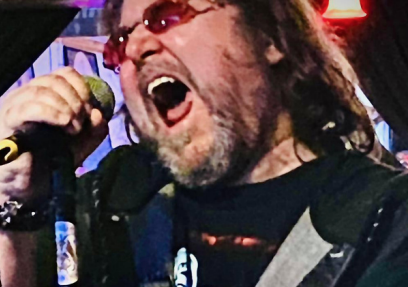
BIO: Steve Cain is a multi-genre poet, lyricist novelist, and short story author. His first book, The Great Inevitable, was published by Losantiville Press in 2019. He has since self-published twelve books of short stories and poetry, as well as a horror novel, Thorn. Several of Steve’s stories have been published in Of Rust and Glass magazine, as well as in the Made of Rust and Glass anthologies. Steve has recorded a CD as a singer with his former Christian metal band, Rising Within. He is currently the lead singer for the heavy metal band Critical Khaos. A safety and environmental manager by day, Steve lives in southern Ohio with his wife and kids, their fur babies, and a multitude of deer, chipmunks, turkeys, and other birds.
EDITOR’S AUTHOR INTERVIEW – STEVE CAIN
Does writing energize or exhaust you?
Both, in a way. When I have inspiration or an idea, it is exciting and energizing while I’m writing. Usually, especially with poetry, I put a lot of myself and emotion into the writing, so that when it’s finished, I can be exhausted, but relieved at the same time. My writing is therapy for me.
What are common traps for aspiring writers?
There are a lot of people who would want to take advantage of you. Some publishers make promises, but small publishing houses can end up costing you money. I would also say that as a writer/artist, don’t assume that your friends and family are going to support you. From what I’ve seen from my own experience and from fellow writers, that just isn’t the case, normally.
If you could tell your younger writing self anything, what would it be?
Keep writing and keep pushing! Whether you are writing a book, a story, a poem, or just journaling, keep going, as that helps to hone your craft.
What was the best money you ever spent as a writer or what is your favorite writing tool?
The best money I ever spent was when I published my first book, The Great Inevitable. It was published through a small publishing house, and I expected them to do everything and cover all the costs, but I had to pay for the artwork, editing, and some of the books as well. What they mainly did was make it available on their website, get my book into some stores, and do some minor marketing. It was a learning experience for sure, and costly, but it got my book out there! I definitely learned what to do and what not to do going forward, and I have opted to self-publish since my first book. I do my own covers, my own editing, and my own marketing. I have creative control of my work, which is very important to me. It reduces my sales, but my writing is mainly for myself anyway.
Have you based any characters on real people in your life?
A lot of my writing is autobiographical. Some people and events in my writing have been based on people or things I have known, but loosely. I think a good writer is going to put a bit of themselves into their writing. That’s where you get the emotion.
What does a successful writing career look like to you?
I would love to be able to be a full-time writer and sell millions of books like Stephen King. However, I like the freedom to write what I want, when I want, and how I want. Ideas get into my head and bug me until I write them down. Then they’re gone. I completely forget about a lot of what I write until I edit or print, then I’m like, “Wow, I wrote this? I don’t remember it!” It really is good therapy, though, as I can release all my emotions. I guess for me, being successful would be having people get moved by something I wrote. If I can make someone smile or help someone who’s having a hard time dealing with something, that’s success. If people can read my work and can relate to it, that’s success.
Do you read your book reviews? How do you deal with bad or good ones?
I do read book reviews when I get them. If the feedback is constructive, I will try to incorporate that feedback into what I do. If it’s not constructive or meaningful, I disregard it.
What was your hardest scene to write?
Not necessarily a scene, but a short story I wrote called, Dead End. As with a lot of my works, it is somewhat autobiographical, about a man who loses his parents and is grieving. When I finished writing the story, I just cried. It took a lot for me to get that out, and the emotion overcame me.
Who would you consider your biggest writing inspiration?
I would probably say Stephen King, as he is my favorite writer, but just because of his writings and his longevity. I also love Brad Meltzer’s storytelling, and I am inspired by the morality behind Milne’s Winnie the Pooh stories, Jan and Stan Berenstain, and Dr. Seuss.
How long did it take to complete your first novel?
It took about five years because I put it away for a long time. This was my one, and currently only, novel, Thorn, which is a horror novel. I think I have some undiagnosed ADD, and I find it hard to focus sometimes. That’s why I primarily write poetry, lyrics, and short stories. I have not had the concentration to sit down and write novels, though I have many ideas. With Thorn, I wrote a little, put it away, wrote a little more, then put it away again for almost five years. When I dug it out, it took on a mind of its own, and I finished it rather quickly.
What is your favorite work that you’ve written and published?
Thorn, my horror novel, is my favorite book that I’ve published. I love the conflict in the main character. He just wants to be good, but other factors make it difficult for him. I have other poems and stories that I may like better, but for one grand work, it’s definitely Thorn.
What is the next major writing goal of yours?
I have a few books of poetry and short stories that are complete but have not been released yet. I think my next one is Through the Rainy Windshield. I also have a book of short stories that centers around a little river village called The Periodic Coffee House. Another non-fiction book that I’ve been working on for a long time is The History of Baseball in Augusta, Georgia: the 1955-1958 Augusta Tigers. I’ve done a lot of research, conducted interviews, collected statistics, and this book has been about 95% complete for a couple of years. I just have to sit down and edit it, which has been challenging because of my lack of concentration. I am looking to finally have it out in time for Spring Training.
Is there anything you would like to share with your readers that you’ve not discussed before?
Just write! Just write! Just write! Don’t write because you want to make money; write because you have to! If you are an artist, you are called to create, and that drives you. If you’re just doing it to try to make money, your work may not seem sincere. Be vulnerable and put yourself in your work. That makes it genuine, and people can recognize that.
Editor’s note: A sad note to relay — Steve died just weeks after this interview, killed during a domestic dispute by his spouse. He was only 51. A great talent taken away much too early. RIP.
 WITH MALICE HORROR MAGAZINE